
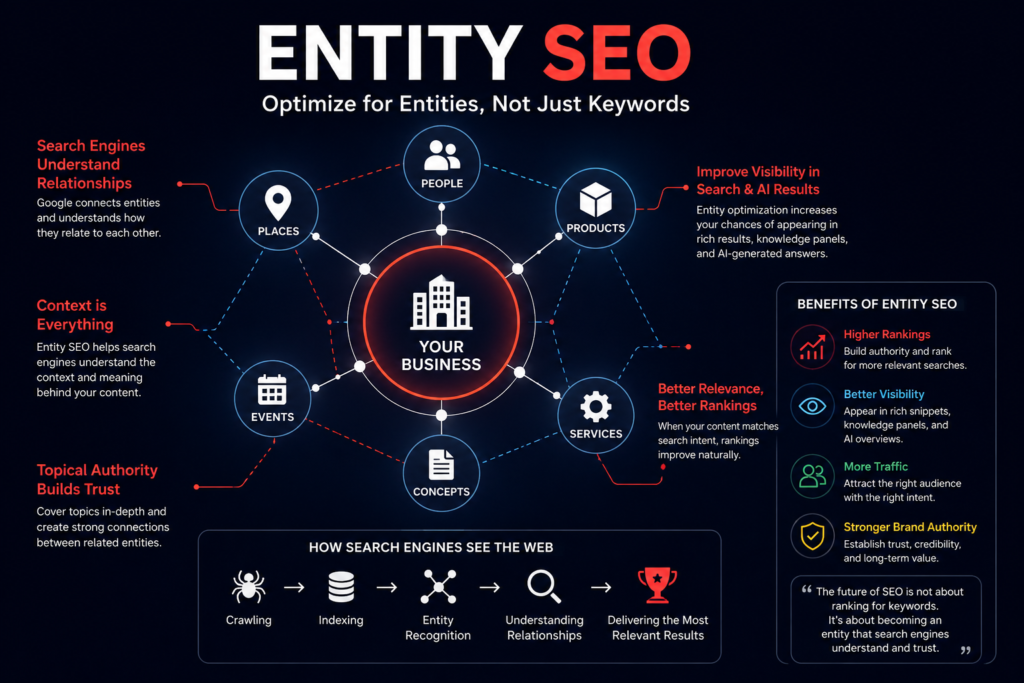
Search Engine Optimization has evolved far beyond keywords. Modern search engines no longer rely solely on matching words—they understand the meaning behind them. This shift has introduced Entity SEO, a strategy that helps search engines recognize people, places, businesses, products, and concepts as connected entities instead of isolated keywords.
As Google’s algorithms become increasingly driven by artificial intelligence, natural language processing (NLP), and semantic search, businesses that optimize for entities gain a significant advantage. Rather than chasing individual keywords, Entity SEO focuses on building topical authority, contextual relevance, and trust.
If you’re looking to future-proof your SEO strategy, understanding Entity SEO is no longer optional—it’s essential.
What is Entity SEO?
Entity SEO is the process of optimizing your website around entities rather than just keywords.
An entity is anything that Google can uniquely identify. This includes:
- Businesses
- Brands
- Products
- Services
- Locations
- People
- Organizations
- Events
- Technologies
- Concepts
For example, when Google encounters the term “Apple,” it doesn’t simply analyze the word. It determines whether you’re referring to Apple Inc., the fruit, or another entity by analyzing context.
This contextual understanding allows Google to provide more accurate search results and answer complex user queries.
Instead of asking:
“How many times does this keyword appear?”
Google now asks:
“What is this page actually about?”
Why Entity SEO Matters
Google’s mission is to understand information the way humans do.
Traditional keyword optimization often created content that was repetitive and unnatural. Today, Google’s AI systems evaluate relationships between topics, concepts, and entities to determine content quality.
Entity SEO helps your website by:
- Improving topical relevance
- Building subject expertise
- Increasing semantic relationships
- Strengthening search intent alignment
- Enhancing visibility in AI-powered search
The result is content that performs better in organic search while providing greater value to users.
Understanding How Google Uses Entities
Google stores information in its Knowledge Graph, a massive database containing billions of interconnected entities and their relationships.
For example, if your website discusses Digital Marketing, Google expects to see related entities such as:
- SEO
- Google Ads
- Content Marketing
- Social Media Marketing
- Analytics
- Conversion Rate Optimization
- Search Intent
- User Experience
- Website Performance
The more complete these relationships become, the easier it is for Google to understand your expertise.
This is why comprehensive content consistently outperforms pages that focus on a single keyword.
Keywords vs Entity SEO
Traditional SEO focuses on matching search terms.
Entity SEO focuses on understanding topics.
| Traditional SEO | Entity SEO |
|---|---|
| Exact Match Keywords | Semantic Relationships |
| Keyword Density | Context & Meaning |
| Single Keyword Targeting | Topic Clusters |
| Individual Pages | Topical Authority |
| Search Volume | User Intent |
| Keyword Optimization | Knowledge Optimization |
Keywords still matter, but they now serve as signals rather than ranking factors by themselves.
The Building Blocks of Entity SEO
1. Topical Authority
Search engines reward websites that demonstrate expertise across an entire subject rather than publishing isolated articles.
For example, a digital marketing website should cover:
- SEO
- Local SEO
- Technical SEO
- Content Marketing
- PPC
- Social Media
- Website Development
- Analytics
- Conversion Optimization
Together, these pages create topical authority.
2. Semantic Search
Semantic search helps Google understand the meaning behind a query.
If someone searches:
“How can I improve my website rankings?”
Google understands related concepts such as:
- SEO
- Backlinks
- Technical SEO
- Page Speed
- Content Quality
- Search Intent
This happens even if the exact phrase isn’t present on the page.
3. Search Intent
Entity optimization starts with understanding why users search.
There are four major search intents:
Informational
Learning about a topic.
Example:
“What is Entity SEO?”
Navigational
Looking for a specific website.
Example:
“Google Search Console”
Commercial Investigation
Comparing products or services.
Example:
“Best SEO Agency”
Transactional
Ready to buy.
Example:
“Hire SEO Expert”
Creating content around each stage improves both rankings and conversions.
How to Optimize for Entity SEO
Create Topic Clusters
Instead of publishing unrelated blog posts, organize content around pillar topics.
Example:
Pillar Page
Digital Marketing
Supporting Articles
- What is SEO?
- Local SEO Guide
- Technical SEO Checklist
- Entity SEO Explained
- Content Marketing Strategy
- Link Building Techniques
- Google Ranking Factors
Each article links back to the main pillar, helping search engines understand your expertise.
Use Structured Data
Schema markup provides explicit information about your content.
Important schema types include:
- Organization
- Local Business
- Person
- Service
- Product
- FAQ
- Article
- Breadcrumb
- Review
Structured data improves Google’s understanding of your entities and increases eligibility for rich results.
Build Internal Linking
Internal links help connect related entities throughout your website.
For example:
A page about SEO should naturally link to:
- Technical SEO
- Content Marketing
- Website Speed
- Core Web Vitals
- Local SEO
These relationships reinforce topical authority.
Write Naturally
Avoid repeating keywords unnecessarily.
Instead, use related terms and natural language.
For example, an article about SEO may naturally include:
- Organic search
- Search rankings
- Website visibility
- Google algorithms
- Crawling
- Indexing
- Search Console
- User experience
This creates semantic richness.
The Role of Google’s Knowledge Graph
The Knowledge Graph connects entities and their attributes.
If your business consistently publishes accurate, well-structured information across its website and digital profiles, Google becomes more confident about your expertise.
This confidence can improve:
- Brand recognition
- Knowledge Panels
- Rich Snippets
- Featured Snippets
- AI-generated search responses
Building a recognizable entity strengthens your online authority over time.
Common Mistakes in Entity SEO
Many websites still rely on outdated SEO practices.
Common mistakes include:
- Publishing thin content
- Keyword stuffing
- Ignoring semantic relationships
- Poor internal linking
- Duplicate content
- Missing schema markup
- Weak topical coverage
- Creating pages solely for search engines
Entity SEO prioritizes quality, relevance, and context instead.
The Future of SEO is Entity-Based
With AI-powered search experiences such as Google’s AI Overviews and conversational search, search engines increasingly rely on entities rather than keywords.
Future SEO success will depend on:
- Demonstrating expertise
- Building topical authority
- Publishing comprehensive content
- Creating semantic relationships
- Optimizing structured data
- Answering user intent completely
Businesses that embrace Entity SEO today will be better positioned for tomorrow’s search landscape.
Final Thoughts
Entity SEO represents the natural evolution of search engine optimization. Instead of focusing solely on ranking for individual keywords, it helps search engines understand your business, your expertise, and the relationships between the topics you cover.
By creating comprehensive content, strengthening internal links, implementing structured data, and building topical authority, you establish your website as a trusted resource in your industry. As search continues to evolve with artificial intelligence and semantic understanding, Entity SEO will become one of the most important foundations of sustainable organic growth.
If your goal is long-term visibility rather than short-term rankings, investing in Entity SEO is one of the smartest decisions you can make.